Launch your Allied Health career with confidence. Send your resume to careers@kinesishealthcare.com.au
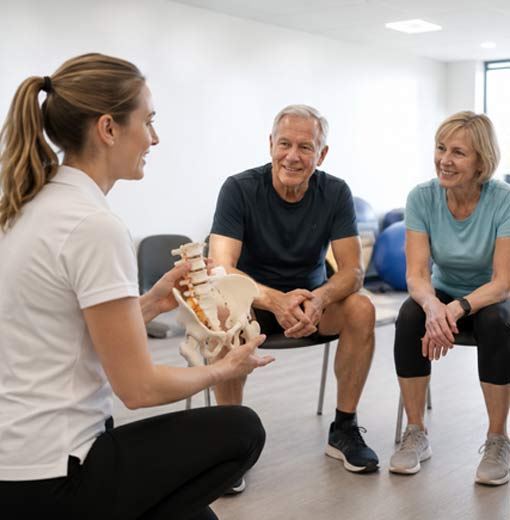
Small groups. A physiotherapist or exercise physiologist in the room. A programme that was written for you after an assessment, not printed for the whole class.
That is the difference between a group class here and a group class anywhere else. You get the accountability and the company of training with other people, without giving up individual prescription.
| Class | For | Cost |
|---|---|---|
| GLA:D — Good Life with Osteoarthritis | Hip and knee osteoarthritis | $60 per session |
| Better Balance — Falls Prevention | Balance loss, falls, unsteadiness | $35 per session |
| Bone Strength & Conditioning | Osteoporosis, osteopenia, low bone density | $45 per session |
| Strength & Functional Exercise | General strength, independence, deconditioning | $45 per session |
We assess your strength, balance, joints, conditions and goals, and work out which class fits — or whether you would do better one-to-one first.
Small groups, supervised throughout, with your own prescribed programme within the session.
We measure again at set intervals so you can see what has changed, and we progress your programme accordingly.
rebates apply for eligible patients. Ask your GP.
plan-managed and self-managed, at NDIS rates.
funded, no out-of-pocket cost to you.
generally claimable where delivered by a physiotherapist. Check your fund.

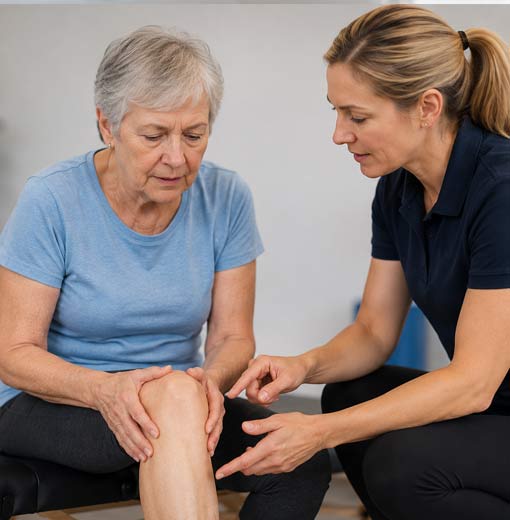
You have been told you have arthritis in your knee or hip, that it is wear and tear, that it will get worse, and that eventually you will need a replacement.
So you have been waiting. Doing less, because it hurts. Which is the one thing guaranteed to make it worse.
GLA:D turns that around. It is an internationally developed education and exercise programme for hip and knee osteoarthritis, and it is built on a large body of research showing that targeted exercise and education reduce pain and improve function.
GLA:D was developed in Denmark and is delivered in Australia under La Trobe University, by physiotherapists who have completed the specific certification training.
The programme has two parts:
two group sessions explaining what osteoarthritis actually is, what the evidence says about managing it, how to control your symptoms, and how to keep exercising for the long term.
a structured programme of twelve supervised group sessions over six weeks, focused on control, strength and the quality of movement through the hip and knee rather than just loading the joint.
That last point matters. Not because surgery is bad — joint replacement is an excellent operation for the right person at the right time. But because a lot of people are offered it before anyone has genuinely trialled loaded, supervised exercise, and many of those people turn out not to need it yet.
That last point matters. Not because surgery is bad — joint replacement is an excellent operation for the right person at the right time. But because a lot of people are offered it before anyone has genuinely trialled loaded, supervised exercise, and many of those people turn out not to need it yet.
We cannot tell you that GLA:D will mean you avoid surgery. We can tell you that going through a structured programme first means the decision is made on much better information — and that if you do go ahead, you go in stronger.
Discounted sessions and memberships purchased in advance are not refundable.
| Service | Price | Details |
|---|---|---|
| Initial Assessment | $115 | - |
| GLA:D Session | $60 | - |
| Full Programme | $630 | 12 Weeks |
| Medicare Chronic Condition Referral | - | Rebate applies. |
| DVA, WorkCover & TAC | - | Funded – Prior approval required. |
| Private Health Extras | - | Generally claimable as physiotherapy. |
The first fall is usually the one nobody tells anyone about.
You catch your foot, you go down in the hallway, you get up, you feel foolish, and you decide to be more careful. So you stop walking on uneven ground. You hold the rail. You stop going out in the evening.
And every one of those sensible adjustments takes away the challenge your balance system needs to stay sharp. Being careful is how balance quietly gets worse.

particularly in the hips, thighs and ankles, because balance recovery is a strength task. When you stumble, you need enough leg strength, generated quickly enough, to catch yourself.
from your inner ear, your eyes, and the sensors in your feet and joints. These can be retrained.
how quickly your body responds, and how much you trust it.
All three decline with inactivity, and all three improve with the right training. The research is clear on the specifics: balance training needs to be genuinely challenging to work, and it needs to be ongoing.
Gentle balance exercises done sitting in a chair will not do it. Which is why this class progresses.
Your assessment ($115). Before you join, a physiotherapist assesses:
The class ($35 per session). Small groups, physiotherapist-supervised, with your own
programme within the session. Sessions include:
Reassessment. We re-measure at set intervals so you can see the numbers move.
We cannot guarantee you will not fall. Nobody can.
What the evidence supports is that structured, progressive, challenging balance and strength training reduces the rate of falls in older adults — and that the effect depends on the training being ongoing. This is not a six-week fix. It is something you keep doing, which is why most participants stay on long term or move into the Longevity Gym.
| Initial assessment | $110 |
| Better Balance class | $35 per session |
| Medicare chronic condition referral | Rebate applies |
| DVA | Funded — no out-of-pocket cost |
| NDIS | As per NDIS rates |
| Home visits — Mobile Rehab | Available |
Your scan came back with a number, and a word you did not expect. Osteopenia, or osteoporosis.
Then you were probably told to be careful. Take your calcium and vitamin D. Do some walking. Do not lift anything heavy.
Two of those are reasonable. The last one is the opposite of what your bones need.
You do not need a diagnosis to start. Building bone is easier before you lose it.

Bone is living tissue. It responds to the loads placed on it by laying down more material where it is needed, and taking it away where it is not.
Walking loads your bones roughly as much as your body already expects. Which is why it maintains bone reasonably well and builds very little.
What builds bone is loading that is genuinely challenging:
meaningful weight, lifted with good technique, gradually increased. Loading the muscle pulls on the bone, and that pull is the signal.
controlled, appropriate impact through the hip and spine, prescribed at a level your bones and joints can handle.
because the fracture that matters is usually the one that follows a fall. Bone density is only half the fracture equation.
We should be straightforward about that, because it is the point.
Under-loading someone with osteoporosis feels safe and achieves very little. This programme is properly supervised, individually prescribed, and progressive — and it is meant to be hard work.
That said, prescription matters enormously here. Some movements genuinely do carry risk with fragile vertebrae — loaded forward bending and twisting in particular. Your programme is builtb around your DEXA results, your fracture history and your spine, and there are things we will deliberately keep out of it. We will explain why.
Bring your DEXA scan results and any fracture history.
We assess strength, posture, balance, spinal mobility, and any existing joint pain. We go
through your medications, including bone medications, and coordinate with your GP. We ask
about your calcium and protein intake and refer you to our dietitian if that needs work —
because training a bone that has no raw materials is a wasted effort.
Small groups, supervised throughout, individually prescribed. Progressive resistance work for the hip and spine, appropriate impact loading, postural and back extensor strengthening, and balance training.
Strength and balance measured regularly. Bone density is generally re- scanned by your GP at their recommended interval — usually one to two years.
| Initial assessment | $115 |
| Bone Strength & Conditioning class | $45 per session |
| One-to-one session | $95 |
| Dietitian consultation | [PRICE TBC] |
| Medicare chronic condition referral | Rebate applies |
| DVA | Funded — no out-of-pocket cost |
| Private health extras | Generally claimable as physiotherapy |
With locations in Werribee and Lara, Kinesis™ Healthcare provides Physio and Healthcare services across Melbourne’s West, including Wyndham, Hobson’s Bay, and Geelong.
Consulting Suite
240 Hoppers Lane Werribee 3030
Wednesday 8.00AM-6.00PM
Thursday 1:00 PM–5:00 PM
269 Princess Hwy, Werribee 3030
Tuesday 12:00 PM–7:00 PM
Shop 4/15 Rushton Street, Werribee VIC 3030
Monday to Friday 8.00AM – 8.00PM
Saturday 9.00 AM – 1.00 PM
33 McClelland Avenue Lara 3212
Monday 9:00 AM TO 2:00 PM
Wednesday 1:00 PM–5:00 PM
Friday 9:00 AM–5:00 PM
Monday To Friday 9:00 AM TO 5:00 PM
With locations in Werribee and Lara, Kinesis™ Healthcare provides Physio and Healthcare services across Melbourne’s West, including Wyndham, Hobson’s Bay, and Geelong.
With locations in Werribee and Lara, Kinesis™ Healthcare provides Physio and Healthcare services across Melbourne’s West, including Wyndham, Hobson’s Bay, and Geelong.
Consulting Suite
240 Hoppers Lane Werribee 3030
Thursday 1:00 PM–5:00 PM
Wednesday 8.00AM-6.00PM
269 Princess Hwy, Werribee 3030
Tuesday 12:00 PM–7:00 PM
Shop 4/15 Rushton Street, Werribee VIC 3030
Monday to Friday 8.00AM – 8.00PM
Saturday 9.00 AM – 1.00 PM
33 McClelland Avenue Lara 3212
Monday 9:00 AM TO 2:00 PM
Wednesday 1:00 PM–5:00 PM
Friday 9:00 AM–5:00 PM
Monday To Friday 9:00 AM TO 5:00 PM










©2026. Kinesis™ Health Care. All Rights Reserved.
OPENING SOON
📍 Shop 4/15 Rushton Street,
Werribee VIC 3030
Register your interest and we’ll keep you
updated on our opening.
Registered Psychologist & Behaviour Support Practitioner | Allied Health Clinical Manager
Puja is an AHPRA Registered Psychologist and Behaviour Support Practitioner with over 17 years of experience, including more than 11 years in Australia. She works with children, adolescents, adults and families across psychological assessment, therapy and positive behaviour support.
Her assessment work covers cognitive, academic, developmental, social and emotional profiles, including ASD, ADHD and intellectual disability — always translated into clear, practical recommendations families can actually use at home, at school and in the community.
As a Behaviour Support Practitioner, Puja works alongside participants, families, carers and support teams to understand what sits behind behaviours of concern and build strategies that improve quality of life, emotional regulation and independence.
Her approach is strengths-based, culturally responsive and collaborative — people should feel heard, informed and involved in decisions about their care.
Rajnish is a highly skilled and compassionate Physiotherapist dedicated torestoring movement, enhancing physical function, and improving the quality of life for her patients.
She holds a Master’s degree in Orthopaedic Physiotherapy, providing her with advanced clinical training in the assessment, diagnosis, and management of complex musculoskeletal conditions. Her academic foundation allows her to seamlessly integrate evidence-based practices with hands-on, patient-centred
care.
With a primary clinical interest in musculoskeletal (MSK) and orthopaedic cases, Rajnish specialises in utilising advanced manual therapy techniques to address joint restrictions, soft tissue dysfunction, and movement limitations. Her expertise spans post-surgical rehabilitation, sports injuries, acute joint
disorders, and chronic pain management. Rajnish believes that successful recovery requires a holistic, individualized approach. By combining precise hands-on manual therapy with targeted therapeutic exercise and comprehensive patient education, she designs personalized recovery pathways that empower individuals to return to their daily activities safely and confidently.
Lavanya Bachwal is an Accredited Practising Dietitian (APD) with over 13 years of clinical experience across India and Australia. She brings more than 2 years of public health experience and over 1 year of private practice experience within the Australian healthcare system. Lavanya specialises in gut health (including Low FODMAP training through Monash University), fertility nutrition, women’s health, and chronic disease management. She supports clients with IBS, digestive concerns, hormonal conditions, and those planning pregnancy or undergoing fertility treatment, including IVF. Her practice is grounded in personalised, evidence-based nutrition care, delivered across fertility, women’s health, metabolic conditions, and general wellbeing.
Fertility and Preconception Nutrition: Support for PCOS, endometriosis, unexplained infertility, IVF preparation, male factor fertility, hormonal imbalance, and preconception optimisation for both partners.
Her approach is practical, culturally sensitive, and deeply personalised, with a strong focus on supporting South Asian communities.
Specialities: Fertility and preconception nutrition, pregnancy and postpartum care, women’s hormonal health, metabolic health, gut health, and chronic disease management.
Gayatri Joshi, Professional Bio: Gayatri is a Melbourne-based physiotherapist with a Master of Physiotherapy from Swinburne University of Technology and a Bachelor of Physiotherapy from India, where she began her career as a qualified physiotherapist managing an independent neurological and paediatric caseload.
Since moving to Melbourne, Gayatri has built experience across a broad range of clinical settings including acute orthopaedics and neurology, sports and performing arts physiotherapy, strength-based rehabilitation and MSK private practice. These experiences have shaped her belief that great physiotherapy is as much about listening and understanding a person’s goals as it is about clinical expertise.
Gayatri has a particular interest in musculoskeletal physiotherapy, chronic pain management and complex rehabilitation. She is drawn to the multidisciplinary model at Kinesis because she believes the best outcomes happen when clinicians think beyond their own discipline and work together around the whole person.
Outside the clinic, Gayatri is an active physiotherapy researcher and co-authored a publication on paediatric developmental milestones in the International Journal of Research and Analytical Reviews. She loves good food, a quiet swim day and unwinding with an intense badminton match and she is always happy to talk about movement, recovery and everything in between.